Case Study #2 – From Source Documents to a Governed Knowledge Assistant
The briefing
The briefing, at a glance
First Heritage FCU deployed Posh’s Knowledge Assistant to give frontline and contact-center staff instant, source-linked access to current policy and product knowledge — a widespread, commoditizing use case where the differentiation is not the technology, but the governance and ground-truth work that produce examiner-ready evidence as a byproduct of the build.
Institution snapshot
- Total assets
- ~$838M (Mar 31, 2026)
- Members / customers
- 50,929 members
- Locations
- 9 branches — Corning, NY
- Specialization
- Consumer & community banking; Steuben/Chemung/Tioga counties
- Primary regulator
- NCUA (Charter #9604)
- Core technology
- Not publicly confirmed — immaterial to this document-centric deployment
- Vendor
- Posh AI — Boston, MA
Growth widened the surface area of what staff had to know precisely.
First Heritage has grown to roughly $838 million in assets, nine branches, and over 50,000 members. Growth of that kind widens the surface area of products, disclosures, and procedures frontline and contact-center staff are expected to know precisely and apply consistently.
Traditional search, static manuals, and LMS coursework did not surface answers fast enough in the moment of a member interaction. In the words of Zach Saunders, Director of Retail Operations & Training: “A lot of our stuff was scattered, folders here, the intranet there. Nothing was really searchable. I’d think, ‘I know that’s in a procedure,’ but finding it could take hours … people didn’t want to waste time digging, so they’d just ask the person next to them — that led to different answers depending on who you asked.”
A document-centric use case, low integration risk, high staff leverage.
The specific gap was instant, trustworthy, source-backed access to current policy and product knowledge, available in the flow of work and refreshed as the institution’s offerings change.
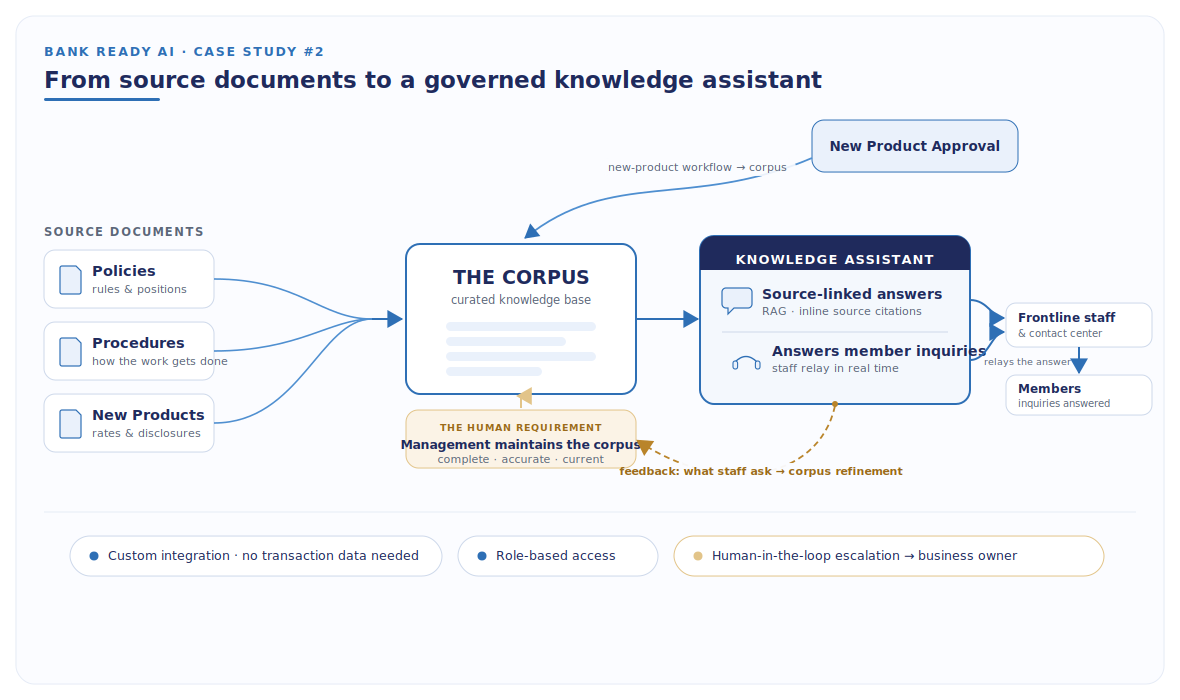
Because Knowledge Assistant consumes institutional documents — not transaction, account, or loan data — it required no integration with the core processor’s real-time framework. The integration layer is the institution’s policy repository and its identity system for role-based access. This document-centric nature is precisely why an internal knowledge assistant can be deployed quickly, at low integration risk, regardless of core.
The capability is proven: 21 community-institution adopters across 7 vendors. The differentiation is not whether an institution can stand one up — it is whether the build produces examiner-ready evidence as a byproduct.
The magic is not in the technology — it’s in those who administer it.
Off-the-shelf models can parse PDFs and produce accurate, source-linked corpus responses. Retrieval-augmented generation and human guardrails add context to a base reasoning-LLM (Sonnet, GPT, etc.). Consequently, ground-truth collection — not finding a reliable LLM — is the biggest hurdle. But it is very much attainable.
Governance
Bank Ready AI recommendation: a written internal AI policy is the roadmap document any community finance leader should put on paper first. (Not a reported First Heritage event.)
Technology
RAG over the institution’s own knowledge base via Posh’s Knowledge Studio, with source citations and role-based access. No core-processor integration required.
People
Reported (Posh client story): the push came from the top — SVP Dave Walker had been tracking AI developments and saw a practical opportunity. Bank Ready AI recommendation: complete a cybersecurity review before adoption.
Operations
Management must maintain a complete, accurate, and current corpus of policies, procedures, and product material — the human activity that enables the technology.
A quiet, staged rollout that started with the contact center.
First Heritage launched Knowledge Assistant in April 2024, rolling it out first to the contact center and then expanding across departments after rigorous internal testing. Pilot testing was adversarial by design — Saunders: “I tried to break it. We pushed hard on all the procedures, asking tons of questions, and ended up making changes to how some were written. It helped us improve our content just by showing us how the AI interpreted it.”
- Before launchExecutive sponsor + problem
Reported: SVP Dave Walker, tracking AI developments, saw a practical opportunity; information was scattered across folders and the intranet, producing inconsistent answers.
- Pre-productionAdversarial pilot
“I tried to break it.” The team stress-tests procedures against the assistant, discovering places where the source content itself needed to be rewritten.
- April 2024Contact-center launch
Knowledge Assistant goes live first in the contact center — the highest-volume, highest-friction environment for policy lookups.
- 2024–2025Department expansion
After rigorous internal testing, the tool expands beyond the contact center to other departments across the credit union.
- OngoingOnboarding by default
New hires are introduced to Knowledge Assistant on day one, so correct, current practice is what they learn first — no outdated habits to unlearn.
Faster answers, consistent practice, and content that improved in the process.
First Heritage has not published quantified performance metrics. What is publicly on record are operational outcomes described by the team running the tool day-to-day.
Zach Saunders, on the operational shift: “It’s just faster. Our frontline can get to answers instantly, and members don’t even realize they’re looking anything up. It’s made everything smoother — better turnaround times, better service. Calls don’t sit on hold as long. It’s noticeable.”
On onboarding: “We introduce new hires to Knowledge Assistant right away. It’s what they learn from the beginning, no outdated habits to unlearn … New hires lean on it constantly, and that encourages more seasoned employees to follow suit. The ripple effect is real.”
Members served
Across 9 branches in NY & PA
Community adopters
Of this use case across 7 vendors — capability is commoditizing
New-hire onboarding
Assistant is the first source of truth new employees learn
What executives should carry into their next board meeting
- 1.
The magic is not the technology. RAG plus human guardrails on a base reasoning-LLM is now off-the-shelf. Ground-truth collection — keeping the corpus complete, accurate, and current — is the real hurdle, and it is attainable.
- 2.
Curiosity gets AI adoption to the front door; a clear problem statement gets it an agenda item at your next committee meeting. Good adoption starts with a business problem like enhanced employee training — not with the model.
- 3.
The document-centric shape of this use case is why it deploys quickly regardless of core. No jXchange, SymXchange, or non-JH equivalent is required. That makes it a natural first governed AI build for many community institutions.
- 4.
Adversarial pilot testing is a governance activity, not just a QA exercise. “I tried to break it” is how you discover that some of your source procedures need to be rewritten before the AI ever meets a member.
- 5.
Start with an internal AI policy on paper, appoint a management champion, and debate the cybersecurity implications openly. Those three moves — which First Heritage made — are the leading indicators of an examiner-ready program.
Full analysis, quotes, and sources
The complete long-form write-up, with every quote, chart, and citation preserved.
Thinking about deploying a Knowledge Assistant at your institution? Start with our free AI Governance Readiness Check to surface the governance depth your deployment needs — in under 2 minutes.
Stay in the loop
New field research on AI adoption in community banking — delivered when we publish.